 D. Bohica
How MMA Taught Me to Write Gladiator Fights That Actually Hit
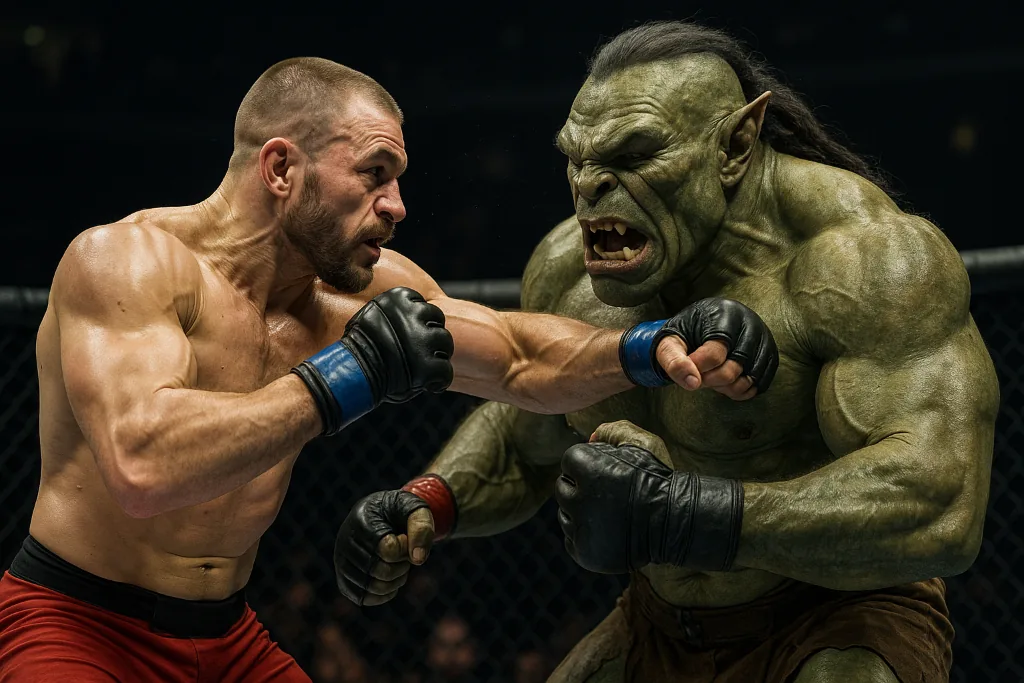
What MMA Taught Me About Writing Fantasy Combat
I used to write terrible fight scenes.
My early drafts were full of lines like "Roar'Z fought fiercely" and "the battle was brutal." Classic telling instead of showing. Then I started studying UFC fights frame by frame, and everything changed.
Real fighters don't "fight fiercely." They adjust their stance when they're tired. They feint with their eyes. They breathe differently when they're hurt. These tiny details make combat feel visceral instead of abstract.
Here's what watching hundreds of hours of MMA taught me about writing gladiator fights that readers can feel in their bones.
❦ ◆ ❦ ◆ ❦
The Problem with Fantasy Combat
Most fantasy fights read like this:
"Theron charged at his opponent with his sword raised. The enemy warrior was skilled, but Theron was faster. They clashed in a fury of steel. After a fierce battle, Theron's blade found its mark."
This tells us the outcome but gives us nothing to experience. We know Theron won, but we didn't feel the fight. Compare that to how MMA commentators describe real action:
"Watch Poirier's left shoulder - see how it drops before he throws that hook? And there it is! Conor's legs buckled for just a split second. He's trying to tie up, looking to buy time, but Poirier's not letting him breathe."
Every detail connects to something physical and immediate. The shoulder drop, the leg buckle, the desperate tie-up attempt - these are concrete actions we can visualize.
❦ ◆ ❦ ◆ ❦
Bodies Tell Stories
In MMA, fighters can't hide their condition. Fatigue shows in dropped hands. Pain shows in favoring one leg. Confidence shows in forward pressure. Their bodies broadcast information constantly.
Bad fantasy writing: "Kael was getting tired."
Better: "Kael's sword tip dipped toward the sand between exchanges, his breathing sharp and shallow through his nose."
MMA-inspired: "Kael's left shoulder sagged lower with each parry, his feet sliding wider apart as his legs demanded more stable footing. Between exchanges, his sword point traced small circles in the sand instead of holding steady guard position."
That last version gives us three specific physical details that all point to the same thing: accumulated fatigue. Just like watching a real fighter's technique break down round by round.
❦ ◆ ❦ ◆ ❦
Real Violence Has Rhythm and Physics
Every MMA fight has a rhythm. Fighters establish distance, probe for openings, explode into action, then reset. The best fantasy combat mirrors this ebb and flow.
Here's a gladiator sequence that applies real fight rhythm:
Roar'Z circled left, watching his opponent's feet more than his blade. The human gladiator was fresh, eager - his sword point tracking Roar'Z's movement like a hunting dog following scent.
Two quick steps forward. A feint high. The human bit, raising his guard.
Roar'Z dropped low and drove his shoulder into the man's midsection. Not to tackle - to create the distance he needed. As his opponent staggered backward, Roar'Z's blade found the gap between armor plates just below the ribs.
The human's breath exploded out in a sharp huff. His sword arm dropped involuntarily as his body curled around the wound. Roar'Z stepped back, sword ready, watching for the counterattack that didn't come.
This sequence follows real combat logic:
- Information gathering (watching feet, reading aggression)
- Setup (feint to create opening)
- Commitment (explosive action)
- Physical consequence (body's involuntary response)
- Reset (tactical awareness returns)
❦ ◆ ❦ ◆ ❦
Fighting Hurts in Specific Ways
MMA fighters don't just "take damage." They absorb liver shots that drop them to their knees. They suffer broken noses that flood their mouths with blood. They get rocked by shots that make their legs forget how to work.
Fantasy writers often skip these details, but they're what make combat feel real.
Generic: "The blow stunned Mira."
Specific: "The mace caught Mira's temple and her vision went white at the edges. Her left leg buckled like a bad joint, and she went down hard on one knee, her free hand automatically reaching for the stone floor to steady herself."
The second version gives us specific injury location, realistic physiological response, and involuntary body mechanics.
❦ ◆ ❦ ◆ ❦
Mental State Shows Physically
Watch any UFC fight and you'll see confidence, desperation, and calculation written across fighters' bodies. The way they move tells you exactly what's happening in their heads.
Confidence: Pressuring forward, hands relaxed, head movement fluid
Desperation: Lunging attacks, overcommitting, sloppy footwork
Calculation: Circling, feinting, maintaining distance
Here's how this looks in gladiator fiction:
Marcus had been circling for thirty seconds, sword tip writing small questions in the air between them. Patient. Hunting for the right moment.
Then something shifted in his stance - weight settling forward onto the balls of his feet, shoulders squaring. Roar'Z recognized the change half a heartbeat before Marcus exploded forward.
The desperation was in the overcommitment. Marcus threw everything behind a straight thrust that would either end the fight or leave him dangerously extended. Roar'Z sidestepped and let momentum carry his opponent past, then brought his pommel down on the back of Marcus's neck.
This shows us Marcus's mental shift from patience to desperation through pure physical description.
❦ ◆ ❦ ◆ ❦
The Magic of Micro-Details
MMA commentary succeeds because it focuses on tiny, specific moments that tell larger stories. The way a fighter's eyes track movement. How their breathing changes. The subtle weight shifts that telegraph intentions.
Before studying MMA: "Jenna attacked relentlessly."
After: "Jenna's attacks came in waves - three-strike combinations followed by quick resets, her back foot sliding forward an inch with each exchange, constantly stealing distance. Her breathing stayed controlled, rhythmic, while her opponent's came in ragged gasps."
The second version shows relentless pressure through specific attack patterns, tactical positioning, and comparative conditioning.
❦ ◆ ❦ ◆ ❦
Putting It All Together
Here's how all these lessons combine in a full gladiator sequence:
The crowd's roar faded to background noise as Roar'Z studied his opponent across twenty feet of blood-stained sand. The veteran gladiator moved like water - economical steps, sword held in a loose grip that could tighten instantly.
Roar'Z tested the distance with a half-step forward. The veteran's eyes flicked down to his feet, then back up. Information gathered and filed away.
They circled each other for long seconds, neither willing to commit first. Then the veteran feinted left and came right, his blade cutting a silver arc toward Roar'Z's ribs.
Roar'Z twisted away from the edge, felt the whisper of steel across his leather vest. His counter came automatically - a quick thrust toward the veteran's exposed shoulder that forced the man to give ground.
The veteran's breathing hitched slightly as he reset his stance. There - a tiny tell. The man's left ankle rolled inward when he planted weight on it. Old injury, maybe, or just accumulated damage from years in the arena.
Roar'Z began pressuring toward that side, not obvious about it, just favoring angles that would force the veteran to pivot on his weak ankle. The older gladiator recognized the tactic and adjusted, but that meant conceding positioning.
Three exchanges later, Roar'Z had backed his opponent toward the arena wall. The veteran knew it too - his attacks became more desperate, longer combinations that left him breathing hard.
When the veteran overextended on a high cut, Roar'Z dropped low and swept the damaged ankle. The man went down hard, sword skittering across sand, and didn't get back up.
This scene includes realistic tactical thinking, specific physical details, natural fight progression, and believable conclusion through technique over brute force.
❦ ◆ ❦ ◆ ❦
MMA taught me that great fight scenes aren't about describing violence - they're about showing human bodies under extreme stress making split-second decisions. Every stumble, every tactical choice, every physiological response tells part of the story.
When you watch real combat, you see that fighting is mostly about small advantages accumulating over time. A slightly better angle. Fresher legs. Reading your opponent's tells. The dramatic moments grow naturally from these tiny building blocks.
That's what makes combat writing feel authentic. Not the clash of steel, but the way a fighter's shoulders betray their next move. Not the blood and thunder, but the way exhaustion changes everything.
Study real fighters. Watch how their bodies tell stories their words never could. Then translate that truth into your fantasy worlds. Writing fantasy that features arena combat? I'm working on "Breach of Balance," a dark fantasy about an orc gladiator whose fire magic burns him from the inside. Follow my blog for more insights into writing realistic fantasy combat.